

What is honing tube?
Release time: 01 Apr,2026
ID: 10
Views:
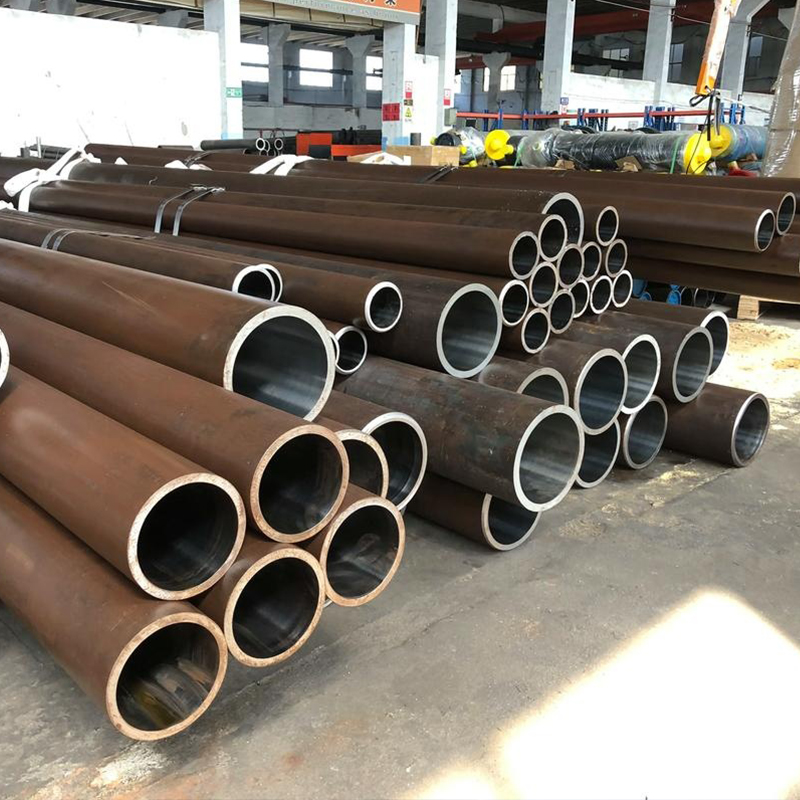
Honing tubes, also known as ground tubes or rolled tubes, are the core precision steel tubes used in hydraulic cylinders (oil cylinders). In simple terms, it is the "body" of the hydraulic cylinder - the piston moves back and forth inside it, so the inner wall of the tube must be extremely smooth and the dimensions must be extremely precise.
1.Core Process
Its name is derived from the key finishing process of honing:
Honing: A grinding head with an embedded oilstone rotates and reciprocates inside a tube, removing a small amount of metal in a manner similar to fine grinding.
Effect: The rough inner surface of ordinary steel pipes is processed into a mirror-like surface (with a roughness of up to Ra0.2 - 0.4 μm), while ensuring extremely high dimensional accuracy (tolerance can reach H8, H7 grade).
2.Main Features
(1) Ultra-high smoothness: The inner wall is as smooth as a mirror, significantly reducing the friction between the piston seal and the tube wall, and extending the service life of the seal.
(2) Precision tolerance: Uniform wall thickness, stable dimensions, ensuring no internal leakage in the hydraulic system under high pressure.
(3) High wear resistance: The surface compressive stress generated during the processing can enhance hardness and make it more resistant to wear.
(4) High load-bearing capacity: Usually made of high-quality carbon steel or alloy steel (such as 45# steel, 27SiMn, etc.), it can withstand high pressure of tens of megapascals.
3.Main Applications
(1) Hydraulic Cylinders: Core components of construction machinery such as excavators, cranes, and dump trucks.
(2) Cylinder: Precision cylinder in automated equipment.
(3) Oil and mining: Drilling equipment, hydraulic supports.
(4) Others: High-precision shaft sleeves, printing machine rollers, etc.
4.The difference from ordinary steel pipes
If ordinary steel pipes are used to make oil cylinders, the rough inner wall will cause the piston seal ring to wear out quickly, resulting in leakage, inability to reach the required pressure, and even jamming. The honed tubes, on the other hand, ensure the efficiency, stability and lifespan of the hydraulic system through precise processing.
Its name is derived from the key finishing process of honing:
Honing: A grinding head with an embedded oilstone rotates and reciprocates inside a tube, removing a small amount of metal in a manner similar to fine grinding.
Effect: The rough inner surface of ordinary steel pipes is processed into a mirror-like surface (with a roughness of up to Ra0.2 - 0.4 μm), while ensuring extremely high dimensional accuracy (tolerance can reach H8, H7 grade).
2.Main Features
(1) Ultra-high smoothness: The inner wall is as smooth as a mirror, significantly reducing the friction between the piston seal and the tube wall, and extending the service life of the seal.
(2) Precision tolerance: Uniform wall thickness, stable dimensions, ensuring no internal leakage in the hydraulic system under high pressure.
(3) High wear resistance: The surface compressive stress generated during the processing can enhance hardness and make it more resistant to wear.
(4) High load-bearing capacity: Usually made of high-quality carbon steel or alloy steel (such as 45# steel, 27SiMn, etc.), it can withstand high pressure of tens of megapascals.
3.Main Applications
(1) Hydraulic Cylinders: Core components of construction machinery such as excavators, cranes, and dump trucks.
(2) Cylinder: Precision cylinder in automated equipment.
(3) Oil and mining: Drilling equipment, hydraulic supports.
(4) Others: High-precision shaft sleeves, printing machine rollers, etc.
4.The difference from ordinary steel pipes
If ordinary steel pipes are used to make oil cylinders, the rough inner wall will cause the piston seal ring to wear out quickly, resulting in leakage, inability to reach the required pressure, and even jamming. The honed tubes, on the other hand, ensure the efficiency, stability and lifespan of the hydraulic system through precise processing.
-
PRODUCTs
-

CONTACT US
Contact person:Judy
WhatsApp: 8618863509246
Email: Judy@sdtmtg.com
Add: Dongchang East Road, Liaocheng Economic and Technological Development Zone, Liaocheng, Shandong, China


©2024 Shandong Tongmao Special Steel Co., Ltd.
Links:
Power by ChaoYueHuLian